Followers

Showing posts with label Iran. Show all posts

Monday, January 12, 2026

The Brilliant Qanats of Iran


Iran has an extensive system of underground irrigation tunnels called "qanats". About 36300 qanats have been found so far. These highlight the resourcefulness and innovation of ancient Persia (Iran). Most are in Isfahan province in the center of the country. Isfahan province is one of the 31 provinces of Iran.


Qanat of Moon
© ICQHS
Author: ICQHS Archive


The qanats are ancient, gravity-fed underground aqueducts that transport water from mountain aquifers to arid plains. They are hand-dug tunnels and vertical shafts and represent a sophisticated, sustainable water management system with several networks now UNESCO World Heritage sites.

These tunnels were made famous by the book Blind White Fish in Persia, a 1953 book by Anthony Smith is which he chronicles a 1950 Oxford University expedition to Iran to find blind, white fish in the country's qanats. While the expedition failed to find the fish, the book became a classic travelogue, detailing the unique qanat system and the rural Persian life encountered by Smith and his companion.

Persian Qanat | Iranian Invention - Iran SafarThe Pigeon Towers of Isfahan ProvinceThe Wind Towers of PersiaIce Houses in the Persian Desert


Friday, January 9, 2026

The Pigeon Towers of Isfahan Province


For centuries the farmers of Isfahan Province in Iran relied on pigeon guano to fertilize their famous melon crops. The towers provided nesting for the pigeons, and their droppings were collected in 3000 squat, circular pigeon towers, each able to house about 14,000 birds. 

Today the pigeon towers are no longer used, but many can be seen along the Zayandeh River south of the Ateshkadeh-ye Esfahan (Fire Temple of Isfahan). Today only around 700 of the pigeon towers remain in the Province.


Wednesday, June 5, 2019

The Wind Towers of Persia


Wind catchers are tall, chimney-like structures that protrude from the rooftops of older houses in many of Iran’s desert cities. In their simplest form, wind catchers harness the cool breezes and redirect them downwards either into the home or into underground storage rooms to refrigerate perishable foods. Studies have shown that wind catchers can reduce indoor temperatures by around 10 degrees.
Read more here.

Related reading: Ice Houses in the Persian Desert; The Pigeon Towers of Isfahan


Tuesday, November 7, 2017

Ice Houses in the Persian Desert


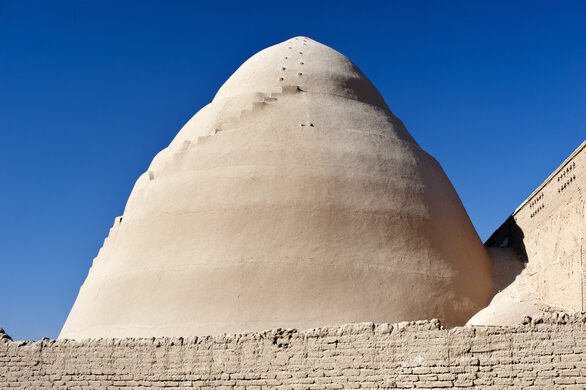
Ancient Persia (Iran) was famous for mud structures to collect fertilizer (pigeon towers) and to create ice in the desert. The ice houses are called yakhchāls.

Beginning around 400 BC, Persian engineers created domed yakhchāls for the production of ice. These can still be seen in Iran in the region of Isfahan. The structures have an underground square-shaped containment area over which the dome was built. The dome and exterior surface of the yakhchal was waterproofed with a layer of mortar called sarooj. It is a mixture of clay, sand, ash, goat hair, and lime.

Ice was brought from the mountains and placed inside the containment area to start the process of freezing. Often walls were built to keep the water shaded as it was channeled to the yakhchāls so it would freeze faster. Water captured in the yakhchal would freeze overnight during the colder months. The ice was then cut into blocks so that it could be transported. In addition to storing drinking water, the yakhchal was also used to keep food from spoiling much as we use refrigerators.

The ice is used to make faloodeh, a traditional Persian frozen dessert made with thin noodles and semi-frozen syrup.

Read more here and here.

Watch this video of the inside of a yakhchal.


Related reading: The Yakhchals of Persia