
Followers

Showing posts with label Jupiter. Show all posts

Sunday, January 16, 2022

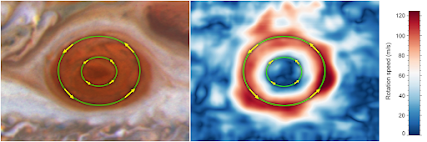
Acceleration of Wind at Jupiter's Red Spot


Credits: NASA, ESA, Michael H. Wong (UC Berkeley)


Students have seen images of Jupiter's Great Red Spot. That dot shows a huge storm and the winds are slowly but steadily accelerating! The acceleration of the winds in the outermost "lane" of Jupiter's Red Spot has been detected by NASA's Hubble Space Telescope, which has monitored the planet for more than a decade.

Researchers analyzing Hubble's "storm reports" from 2009 to 2020 found that the average wind speed within the boundaries of the storm's high-speed ring has increased by up to 8 percent and exceed 400 miles per hour. In contrast, the winds near the storm's innermost region, set off by a smaller green ring, are moving significantly more slowly. Both move counterclockwise.

Astronomers have pursued ongoing studies of the "king" of solar system storms since the 1870s. The Great Red Spot is an upwelling of material from Jupiter's interior. If seen from the side, the storm would have a tiered wedding cake structure with high clouds at the center cascading down to its outer layers. Astronomers have noted that it is shrinking in size and becoming more circular than oval in observations spanning more than a century. The current diameter is 10,000 miles across, meaning that Earth could still fit inside it.


Read more here.

Friday, August 9, 2019

Hubble Catches Jupiter's Vibrant Colors


New Hubble Space Telescope view of Jupiter, taken on June 27, 2019.
Credit: NASA, ESA, A. Simon (Goddard Space Flight Center) and M.H. Wong (University of California, Berkeley)


A new Hubble Space Telescope view of Jupiter, taken on June 27, 2019, reveals the giant planet's trademark Great Red Spot, and a more intense color palette in the clouds swirling in Jupiter's turbulent atmosphere than seen in previous years. The colors, and their changes, provide important clues to ongoing processes in Jupiter's atmosphere.

The colorful bands of ammonia clouds, which flow in opposite directions at various latitudes, result from different atmospheric pressures. Lighter bands rise higher and have thicker clouds than the darker bands.

The Great Red Spot is a towering structure, whose upper haze layer extends more than 3 miles (5 kilometers) higher than clouds in other areas. The gigantic ovoid structure, with a diameter slightly larger than Earth's, is a high-pressure wind system called an anticyclone that has been slowly downsizing since the 1800s. The reason for this change in size is still unknown.

In recent months observers have seen some changes in the Red Spot, described as "flaking." However, the data indicates that the Spot is not going to disappear any time soon. Its position has never shifted. Twin jet streams that circle the planet in opposite directions lock the storm in place.

Observations of Jupiter have come a long way from the early days of the planet's exploration. On October 18, 1989 the space probe Galileo, named after Galileo Galilei, was launched to study the planet Jupiter. The space probe orbited Jupiter 35 times then in 2003 was terminated by sending it into Jupiter's atmosphere at a speed of over 48 kilometers per second (30 mi/s), eliminating the possibility of contaminating local moons with Earth bacteria.

The Galileo probe took close-ups on Jupiter’s rings and found evidence that its icy moons might hold atmosphere.