Followers

Showing posts with label astronomy. Show all posts

Wednesday, June 5, 2024

Annie Maunder: Pioneer Astronomer


Annie Scott Dill Maunder FRAS was an Irish-British astronomer, who recorded the first evidence of the movement of sunspot emergence from the poles toward the equator over the Sun's 11-year cycle. She captured the longest coronial streamer (a ray like structure coming out from the sun) on record.

Annie was regarded as an expert in eclipse photography and was asked to take charge of photography of the Canadian Government's eclipse expedition to Labrador.

Annie was the daughter of the Rev William Andrew Russell, minister of 2nd Strabane Presbyterian Church, Co Tyrone, Ireland. She attended the Ladies’ Collegiate School, Belfast, and Girton College Cambridge, where she attained honors in the mathematical tripos (degree) examinations in 1889 and was Girton’s top mathematician of her year.

She began working at the Astronomer Royal in 1891. She was assigned to work in the solar department under its chief (Edward) Walter Maunder, photographing the sun daily through a telescope, weather permitting; then developing the photographs and examining the images with a measuring micrometer.

Sunspots were of particular interest to the department. Russell witnessed a giant spot in July 1892, and the resulting magnetic storm - a disturbance of the Earth’s magnetic field caused by material emanating from the sun in a manner not fully understood at the time - was recorded on the observatory’s instruments.

Annie joined the British Astronomical Association (BAA), and in 1894 was made editor of its journal, a role she carried out for 35 years.


Sunday, January 16, 2022

Acceleration of Wind at Jupiter's Red Spot


Credits: NASA, ESA, Michael H. Wong (UC Berkeley)


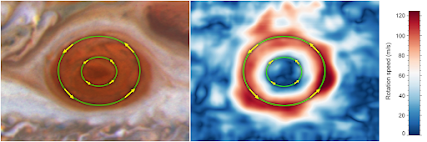
Students have seen images of Jupiter's Great Red Spot. That dot shows a huge storm and the winds are slowly but steadily accelerating! The acceleration of the winds in the outermost "lane" of Jupiter's Red Spot has been detected by NASA's Hubble Space Telescope, which has monitored the planet for more than a decade.

Researchers analyzing Hubble's "storm reports" from 2009 to 2020 found that the average wind speed within the boundaries of the storm's high-speed ring has increased by up to 8 percent and exceed 400 miles per hour. In contrast, the winds near the storm's innermost region, set off by a smaller green ring, are moving significantly more slowly. Both move counterclockwise.

Astronomers have pursued ongoing studies of the "king" of solar system storms since the 1870s. The Great Red Spot is an upwelling of material from Jupiter's interior. If seen from the side, the storm would have a tiered wedding cake structure with high clouds at the center cascading down to its outer layers. Astronomers have noted that it is shrinking in size and becoming more circular than oval in observations spanning more than a century. The current diameter is 10,000 miles across, meaning that Earth could still fit inside it.


Read more here.

Wednesday, February 10, 2021

An Unknown Planet?


The binary stars Alpha Centauri A and Alpha Centauri B, and in the background the faint red dwarf Alpha Centauri C, also known as Proxima Centauri.


Astronomers have glimpsed what seems to be an unknown planet. In Nature Communications, the research team describes how infrared observations for 100 hours in May and June 2019 revealed a bright dot they have been unable to explain. If confirmed as a planet, the sighting would be the first to directly image an exoplanet around a nearby star.

Scientists spotted the bright dot near Alpha Centauri A, the closest star system to the Earth. It appears to be one of a pair of stars that swing around each other so tightly they appear to be a single star in the southern constellation of Centaurus. The binary star system is 4.37 light years away, a relatively short distance given the expanse of the cosmos. 

The researchers are referring to it as a “planet candidate” until further observations can verify the sighting.

The astronomers used the Very Large Telescope, or VLT, operated by the European Southern Observatory located in Chile’s Atacama Desert. A new coronagraph on the instrument blocks light from Alpha Centauri, making it easier to spot orbiting worlds.

Pete Klupar, the chief engineer of the Breakthrough Initiatives, said,“We’re trying to see a flashlight right next to a lighthouse.”

Read more here.

Tuesday, September 1, 2020

Corn Moon Rising


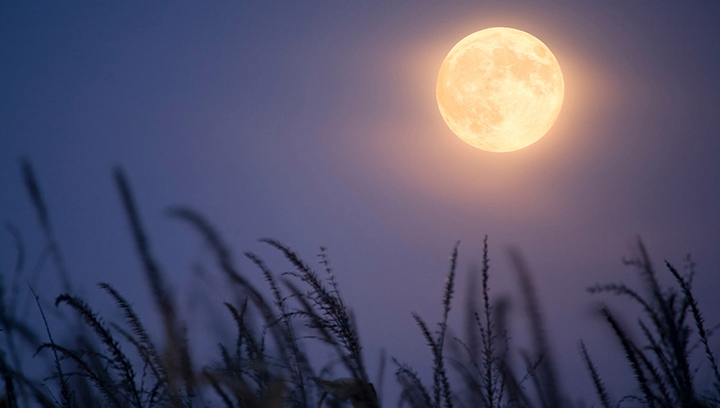
On Wednesday, September 2 the full moon, called the Corn Moon - will reach peak fullness at 1:22 a.m. EDT (5:22 UTC). The Moon will appear full for about three days, from Monday evening through Thursday morning. The Corn Moon occurs every 3 years.

In Europe, the Corn Moon is called the Fruit Moon, as fruits ripen around this time, and the Barley Moon, from the barley harvest.

Coming so early in the month, this sets the stage for two full moons in October. The second full moon - called the Harvest Moon - will shine on Oct. 31.

The Algonquin tribes called this the Corn Moon, as this was the time for gathering their main staple crops of corn, pumpkins, squash, beans, and wild rice.


Friday, August 9, 2019

Hubble Catches Jupiter's Vibrant Colors


New Hubble Space Telescope view of Jupiter, taken on June 27, 2019.
Credit: NASA, ESA, A. Simon (Goddard Space Flight Center) and M.H. Wong (University of California, Berkeley)


A new Hubble Space Telescope view of Jupiter, taken on June 27, 2019, reveals the giant planet's trademark Great Red Spot, and a more intense color palette in the clouds swirling in Jupiter's turbulent atmosphere than seen in previous years. The colors, and their changes, provide important clues to ongoing processes in Jupiter's atmosphere.

The colorful bands of ammonia clouds, which flow in opposite directions at various latitudes, result from different atmospheric pressures. Lighter bands rise higher and have thicker clouds than the darker bands.

The Great Red Spot is a towering structure, whose upper haze layer extends more than 3 miles (5 kilometers) higher than clouds in other areas. The gigantic ovoid structure, with a diameter slightly larger than Earth's, is a high-pressure wind system called an anticyclone that has been slowly downsizing since the 1800s. The reason for this change in size is still unknown.

In recent months observers have seen some changes in the Red Spot, described as "flaking." However, the data indicates that the Spot is not going to disappear any time soon. Its position has never shifted. Twin jet streams that circle the planet in opposite directions lock the storm in place.

Observations of Jupiter have come a long way from the early days of the planet's exploration. On October 18, 1989 the space probe Galileo, named after Galileo Galilei, was launched to study the planet Jupiter. The space probe orbited Jupiter 35 times then in 2003 was terminated by sending it into Jupiter's atmosphere at a speed of over 48 kilometers per second (30 mi/s), eliminating the possibility of contaminating local moons with Earth bacteria.

The Galileo probe took close-ups on Jupiter’s rings and found evidence that its icy moons might hold atmosphere.


Wednesday, June 19, 2019

New Earth-Like Planets Studied


An international research team led by the University of Göttingen has discovered two new Earth-like planets near one of our closest neighboring stars. "Teegarden's star" is only about 12.5 light years away from Earth and is one of the smallest known stars. It is only about 2,700 °C warm and about ten times lighter than the Sun. Although it is so close to us, the star wasn't discovered until 2003. The scientists observed the star for about three years. The results were published in the journal Astronomy and Astrophysics.

Their data clearly show the existence of two planets. "The two planets resemble the inner planets of our solar system," explains lead author Mathias Zechmeister of the Institute for Astrophysics at the University of Göttingen. "They are only slightly heavier than Earth and are located in the so-called habitable zone, where water can be present in liquid form."

Read the Science Daily report here.


CARMENES Telescope Used

Despite its proximity, this nearby Teegarden's star was only discovered back in 2003. About ten times lighter than our own Sun and one of the smallest stars we know of, the old red dwarf, which is roughly 8 billion years old, has proved a challenge to research.

According to the team, other planetary systems around similar stars have always been detected using the transit method, when an orbiting planet passes in front of a star, blocking Earth's view and causing the bright celestial object to darken for a brief moment.

The alignment and dimness of Teegarden wouldn't lend itself to this method however, so astronomers instead used the CARMENES next-generation telescope designed specifically for such situations. Located at Spain's Calar Alto Observatory, the instrument allowed the researchers to look for any changes in the mini-star's radial velocity.

Read the Science Alert report here.


Tuesday, January 23, 2018

Priests of the Ancient World Studied Astronomy


In the ancient world, priests were the wise men of learning. They were scribes, architects, metal workers, medical practitioners, and astronomers. Young men of the ruling class studied under priests at famous temples. These were the universities of the ancient world.

The priestly lines known as Horite Hebrew served rulers and were dispersed very widely. Some were serving rulers in the area of Lake Chad in central Africa some in Mesopotamia, some in southern Europe, and some in India. Plato recounts how the priests of the Nile had been keeping astronomical records for 10,000 years. He studied for 13 years in Memphis under a priest named Sechnuphis. Many Greek philosophers studied at Egyptian temple schools.

Iamblichus wrote that Thales of Miletus insisted that Pythagoras had to go to Memphis to study because the Egyptian priests were a great source of knowledge and wisdom, especially when it came to the natural sciences, medicine, and astronomy. 

This recently recovered fragment of a circular star calendar from the library of King Ashurbanipal (668-627 BC) is an example of the relationship between the priest-astronomers and the King. This Babylonian star calendar was found in an underground library in Nineveh, Iraq.

By observing the heavens, ancient astronomers were able to understand that the stars and the planets move relative to one another in a fixed and stable pattern. There are seven visible planets and stars to the human eye, although all were called "stars" by the ancients. They included the Sun and the Moon. The seven celestial bodies were perceived as urns or bowls from which God poured forth both blessings and curses. In Revelation 16, the angels are instructed to go and pour out the seven bowls of divine indignation upon the earth. Bowls were used both to bless and to curse. The curse or the blessing was written inside the bowl and then water was poured out from the bowl.


Ancient cursing bowl found in Egypt.


According to the pre-Socratic philosopher, Heraklitus of Ephesus, these bowls carried the stars and other celestial bodies. Heraklitus received this idea from the Nilotic priests who explained the diurnal motion of the fixed stars as they revolved around a point above the north pole, and the apparent motions of the sun, the moon and planets.

Even today, we speak of blessings coming down from heaven. James speaks of every good gift coming down from the Father of lights.


Tuesday, January 2, 2018

2018's First Total Lunar Eclipse


The first eclipse of 2018 will be a total lunar eclipse on Jan. 31. It is popularly referred to as a Blue Moon. Such a skywatching event hasn't happened for more than 150 years. The eclipse will be visible in the evening sky to people living in central and eastern Asia, Indonesia, New Zealand and in southwestern Australia.

Blue Moons happen about once every 2.7 years.

Read more about it here.


Tuesday, October 31, 2017

Teen Discovers Lost Mayan City


3401AD6400000578-0-image-a-24_1462873315997


A young teen who has a keen interest in the ancient Mayan culture and the stars has made a truly incredible discovery. William Gadoury has always been fascinated with ancient civilizations and in particular his imagination was captured by how they used to worship the stars. He found that all of the ancient Mayan cities matched up with the brightest stars in the sky. Using maps of the night sky, satellite images and even google maps he found that 117 Mayan cities perfectly matched up with the constellations we see in the night sky.

One constellation in particular was a little odd compared to the rest as it was made up of 3 stars but William could only find 2 cities to match up with it which led him to believe that there could be a hidden city still to be discovered.

Read more here


Wednesday, October 18, 2017

How Heavy Elements are Produced


An artist’s illustration of merging neutron stars.
Credit: Robin Dienel; Carnegie Institution for Science


Monday's (Oct. 16) historic announcement of the detection of gravitational waves produced by two colliding neutron stars has provided explanation as to where in the elements heavier than iron are synthesized.

Until astrophysicists were able to observe the merger of two neutron stars, there only had theories about how heavy elements like gold, platinum and lead are created in the cosmos.

Neutron stars are the corpses of massive stars whose cores collapsed in supernova explosions. While they’re not that big, they’re incredibly dense, packing a sun’s worth of mass into the size of a city. A teaspoon of neutron-star stuff weighs around a billion or so tons.

Neutron stars contain some of the building blocks of atomic nuclei. If these neutrons are somehow released from a neutron star, they undergo reactions that allow them to stick together, creating elements heavier than iron. All of the post-iron elements are formed in these supernova explosions. So much energy is released during a supernova explosion that the freed energy and copious free neutrons streaming from the collapsing core drive massive fusion reactions, past the formation of iron.

Researchers are witnessing a distant heavy-element factory synthesizing "maybe hundreds of Earth masses' [worth] of gold and … maybe 500 Earth masses' worth of platinum," astrophysicist Daniel Kasen said in a new video.


Wednesday, September 27, 2017

The Southern Lights


An astronaut on the International Space Station (ISS) has shared some stunning footage of the Aurora Australis, otherwise known as the southern lights.

Italian astronaut Paolo Nespoli captured this beautiful aurora display as the ISS passed over the Southern Hemisphere. The display's vibrant colors lit up the southern sky as the Antarctic Circle was just emerging from the long winter night. While Nespoli took the video on Aug. 20, the European Space Agency (ESA) released it on Sept. 15.

Go here to see the images.


Friday, September 15, 2017

RIP Cassini. Job well done!


NASA received its last data transmission from the Cassini spacecraft at 4:55:46 a.m. PDT (7:55:46 a.m. EDT, 1146 GMT) on Friday, Sept. 15, before losing contact with the probe as it hurtled into Saturn's atmosphere and broke apart.

Cassini orbited Saturn for 13 years before its fiery grand finale. NASA officials expect that Cassini broke apart about 45 seconds after that final transmission, due to the intense friction and heat generated by the fall.

Cassini's descent into Saturn was intentional. The spacecraft was rapidly running out of fuel, after spending nearly 20 years in space, and NASA scientists decided to make use of the mission's inevitable conclusion. By crashing into Saturn, Cassini had the opportunity to see what the planet's upper atmosphere is made of, and that's the data that the probe sent back to Earth during its final few moments of life. Read more here.


Monday, September 11, 2017

Monster Solar Flares


The sun fired off another powerful solar flare on Sunday, Sept. 10. It was the seventh solar flare in seven days.

There are three categories of solar flares, and Sunday's was the highest classification: an "X" event. Two of the other recent flares were also X-class, including Wednesday's (Sept. 6) X9.3 flare, the strongest solar blast in 12 years.

The effects of such powerful flares include interruption or degraded communications on land and at sea.

Read more here


Friday, September 1, 2017

Asteroid 3122 Florence


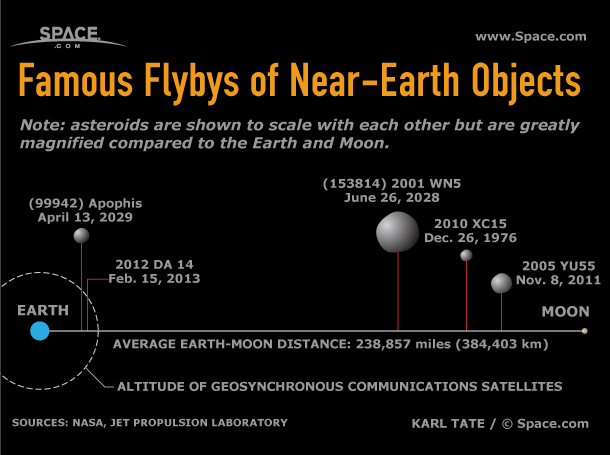
A mountain-size asteroid zoomed past Earth on the morning of Friday, September 1st. It is the largest asteroid to come near Earth since NASA starting tracking asteroids. It passed at a distance of about 4.4 million miles from Earth.

Florence was discovered by astronomer Schelte "Bobby" Bus in 1981 at Australia's Siding Spring Observatory. The space rock loops around the sun every 2.35 years on an elliptical path, getting as close to our star as 1 astronomical unit (AU) and as far away as 2.5 AU. (One AU is the average Earth-sun distance — about 93 million miles, or 150 million km.)

Go here to see asteroid 3122 Florence, as seen by the Virtual Telescope Project on Aug. 30, 2017 — two days before its closest approach to Earth.

Monday, August 28, 2017

Asteroid Florence to Pass Earth


An asteroid named Florence will fly past Earth on Sept. 1. Florence measures 2.7 miles (4.4 kilometers) across, and is the largest object to give our planet a close shave since NASA began tracking these types of near-Earth asteroids.

Florence will pass Earth at a safe distance of 4.4 million miles (7 million kilometers). That is about 18 times the average distance from Earth to the moon, or 18 X 238,857 miles. Watch the video simulation of the track of this asteroid here.

Many asteroids have a moon and even satellites. The dog-bone shaped asteroid Kleopatra has two moons. These moons were named Alexhelios and Cleoselene in 2011. this year.

Monday, August 21, 2017

Saturday, August 12, 2017

Saros Cycles and Ecplises


Solar and lunar eclipses occur in cycles known as the Saros. The sarosis a period of approximately 223 synodic months (approximately 18 years, 11 days, 8 hours), that can be used to predict eclipses of the Sun and Moon. A series of eclipses that are separated by one saros is called a saros series. It is believed that the Greek word saros comes from the Babylonian word "sāru" which refers to the number 3600.

Abraham's Nilotic ancestors were experts at predicting eclipses because they had been observing patterns in the heavens and keeping records of astronomical events for thousands of years.

By 4245 BC, the priests of the Upper Nile had already established a calendar based on the appearance of the star Sirius that becomes visible to the naked eye once every 1,461 years. Apparently, Nilotes had been tracking this star and connecting it to seasonal changes and agriculture for thousands of years. This is verified by the Priest Manetho who reported in his history (241 BC) that Nilotic Africans had been “star-gazing” as early as 40,000 years ago. Plato, who studied in Egypt for 13 years, claimed that the Africans had been tracking the heavens for 10,000 years.


Priest-astronomer Taitai, 18th Dynasty ~1380 B.C. 
Berlin, Neues Museum, Ägyptische Sammlungen


Temple architecture of ancient Egypt provides evidence that Egyptians observed solar eclipses over 4,500 years ago. The Zodiac of the Dendera Temple shows two disks in the constellation of Pisces. One is the moon and the other disk contains the Wadjet or Eye of Horus decorated with the markings of the eyes of a hawk, the totem of Horus. When the right eye is shown it indicates a solar eclipse. David Smith explains that "a nearly total solar eclipse occurred on a date corresponding very closely to the actual depiction of the positions of the planets in the constellations and the position of the disk containing the Wadjet eye in 51 B.C."

An ancient Egyptian story tells of Horus losing an eye in his fight with Set and it is possible that this story is based on an astronomical event. It suggests observation of a solar eclipse.

References:

Smith, David G., Total solar eclipses in Ancient Egypt – a new interpretation of some New Kingdom texts.

Neugebauer, The Exact Sciences in Antiquity. Brown University Press, p. 195.


Friday, August 4, 2017

WASP 121b


A huge alien planet has a stratrosphere, according to a new study co-authored by Mark Marley, of NASA's Ames Research Center in California's Silicon Valley. 

Marley said in a statement: "This result is exciting because it shows that a common trait of most of the atmospheres in our solar system — a warm stratosphere — also can be found in exoplanet atmospheres."

"We can now compare processes in exoplanet atmospheres with the same processes that happen under different sets of conditions in our own solar system," Marley added.

WASP-121b lies very close to its host star, completing one orbit every 1.3 days, and is extremely hot. 

Read about it here.


Friday, April 28, 2017

Hurricane on Saturn


NASA's Cassini spacecraft dove between Saturn and its rings on April 26, snapping the closest-ever views of Saturn's atmosphere. The images that streamed back indicated that the probe had survived its journey. They show intricate structures and a dark, swirling storm-like feature which NASA called a "giant hurricane".

See the photos here.


Friday, March 31, 2017

Finding Exoplanets


An artist's rendering of Kepler-34b, an exoplanet believed to orbit two stars. 
Credit: David A. Aguilar, Harvard-Smithsonian Centre for Astrophysics


It has been 85 years since the discovery of the planet Pluto, and astronomers want to find a new planet by looking for a pulsar. A pulsar is a highly magnetized, rotating neutron star or white dwarf, that emits a beam of electromagnetic radiation.

By carefully observing the light from a distant star, astronomers can detect the changes in the wavelengths of light called redshifting and blueshifting. They detect an exoplanet by observing over years the orbital wobble the occurs due to gravitation pull between the planet and the star.

An instrument called HARPS-North helps NASA's planet-scouting Kepler spacecraft confirm new planets.This spectrograph detects the tiny radial velocity signal induced by planets if they orbit close to their star.

"HARPS" stands for "High-Accuracy Radial velocity Planet Searcher." A spectrograph splits the light from a star into its wavelengths or colors, similar to the way a prism splits wavelengths and produces a colorful array. Chemical elements absorb light of specific colors, leaving dark lines in the star's spectrum. Those lines wobble slightly due to the gravitational tug of an orbiting planet on its parent star.

There are 5 ways to find an exoplanet. They are described in this NASA presentation.


Related reading: The TRAPPIST-1 System