
Followers

Showing posts with label MIT. Show all posts

Monday, May 9, 2022

Seawater to Drinking Water


MIT researchers have developed a suitcase-sized portable desalination unit that can remove particles and salts to render drinking water that exceeds World Health Organization quality standards. The device runs with the push of one button and requires less power to operate than a cell phone charger. It also can be charged by solar power.

Unlike other portable desalination units that require water to pass through filters, this device utilizes electrical power to remove particles from drinking water. Eliminating the need for replacement filters greatly reduces the long-term maintenance requirements.

The unit relies on ion concentration polarization (ICP). Rather than filtering water, the ICP process applies an electrical field to membranes placed above and below a channel of water. The membranes repel positively or negatively charged particles — including salt molecules, bacteria, and viruses — as they flow past. The charged particles are funneled into a second stream of water that is eventually discharged.

The researchers also created a smartphone app that can control the unit wirelessly and report real-time data on power consumption and water salinity.

This unit could be deployed in remote and severely resource-limited areas, such as communities on small islands or aboard seafaring cargo ships. It also could be used to aid refugees or by soldiers carrying out long-term military operations.

Read more here and here.


Saturday, February 5, 2022

MIT Engineers Rock the "Impossible"


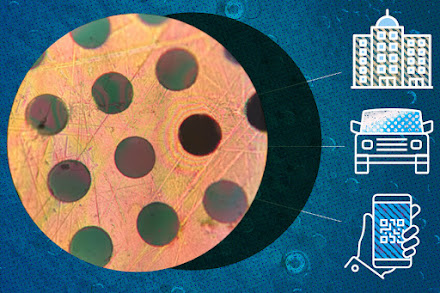
Using a novel polymerization process, MIT chemical engineers have created a new lightweight material stronger than steel. The new substance is the result of polymerizing a material in two dimensions.

The new material is a two-dimensional polymer that self-assembles into sheets, unlike all other polymers, which form one-dimensional, spaghetti-like chains. Until now, scientists had believed it was impossible to induce polymers to form 2D sheets.

The researchers found that the new material’s elastic modulus — a measure of how much force it takes to deform a material — is between four and six times greater than that of bulletproof glass. They also found that its yield strength, or how much force it takes to break the material, is twice that of steel, even though the material has only about one-sixth the density of steel.

Such a material could be used as a lightweight, durable coating for car parts or cell phones, or as a building material for bridges or other structures, says Michael Strano, the Carbon P. Dubbs Professor of Chemical Engineering at MIT and the senior author of the new study.

“We don’t usually think of plastics as being something that you could use to support a building, but with this material, you can enable new things,” he says. “It has very unusual properties and we’re very excited about that.”

The researchers have filed for two patents on the process they used to generate the material, which they describe in a paper appearing today in Nature. MIT postdoc Yuwen Zeng is the lead author of the study.

Read more here and here.