Followers

Showing posts with label biology. Show all posts

Thursday, September 19, 2024

Hydras May be Clue to Cancerous tumors


Freshwater hydra feeding.
Photo credit: Motic America, May 17, 2022


Transmissible cancers are rare. Scientists have spotted only about a dozen examples, mostly in mussels and their relatives.

Transmissible cancers cells can spread from one individual to another, like an infectious disease. Two transmissible tumors nearly wiped out the Tasmanian devil. Another causes unsightly tumors in dogs’ genitals.

In a paper published in the Proceedings of the Royal Society B, scientists report the spontaneous generation of transmissible tumors in the lab. The discovery was made in small, anemone like freshwater animals named hydras that are known to be cancer prone. Researchers hope the finding will help them better understand how these tumors develop, evolve, and spread, which could ultimately help prevent or control transmissible cancers in wildlife.

Hydras might seem to be an unexpected choice for researching cancer, but the freshwater cnidarian Hydra oligactis readily develop tumors when overfed in captivity, which makes them an excellent choice for studying how cancers arise. They reproduce asexually by generating clones of themselves through “budding." The buds form from the body wall, grow into miniature adults and break away when mature. These creatures can help researchers gain insight into the genetics of cancer.

Thursday, March 25, 2021

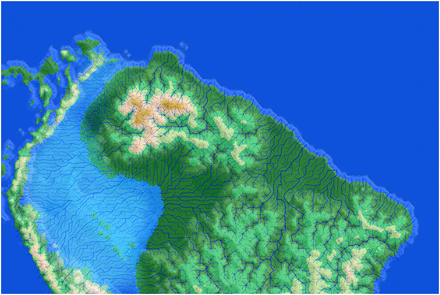
The Western Amazon Was a Sea?


Image credit: Tacio Cordeiro Bicudo (University of São Paulo, São Paulo, Brazil)


At intervals during the Miocene (23.03 to 5.333 million years ago) the Caribbean ocean surged into the western Amazon, creating a continuous inland sea. Saltwater currents mixed with fresh water from torrential rains. 

Researchers believe that the periods of flooding were relatively brief. For the majority of the epoch, the ocean receded, leaving a freshwater megawetland of interconnected lakes.

Scientists have found sediments as well as a fossilized shark tooth and a marine mantis shrimp, consistent with two separate Caribbean flooding periods in the last 20 million years. The geological and biological evidence suggests that during the Miocene the western Amazon region was a massive wetland, twice the size of Texas.

Read more here.


Saturday, November 7, 2020

Ice Age Plant Resurrected from Frozen Seeds


The oldest plant ever to be “resurrected” has been grown from 32,000-year-old seeds, beating the previous record holder of the Judean Palm by 30,000 years.

The narrow leafed perennial campion called Silene stenophylla is a small plant whose modern relatives are found in eastern Russia and northern Japan. This species that grows on stony cliffs or sandy shores. Once a year, it produces five-petalled flowers that range in color from white to pink to lilac.

A team of scientists from Russia, Hungary, and the United States recovered frozen Silene stenophylla seeds in 2007 while investigating about 70 ancient ground squirrel burrows or caches, hidden in permanently frozen deposits in northeastern Siberia.

The age of the seeds was estimated at between 20,000 and 40,000 years, dating the seeds to the Pleistocene epoch. More than 600,000 fruits and seeds thus preserved were located at the site.

Normally, the rodents would have eaten the food in their larders, but in this case a flood or some other weather event buried the area. The larders were at the level of the permafrost which resulted in the material freezing almost immediately. More than 600,000 fruits and seeds thus preserved were located at the site.

Years later, a team of scientists at the Russian Academy of Sciences successfully revived one of the plants: a flowering plant from a 32,000-year-old fruit!


Friday, December 13, 2019

Assessing the Health of Bee Colonies


Honey is full of proteins, but sugars in the sticky substance make those proteins hard to study. Now, one scientist has figured out a way to pull proteins from the honey, revealing the world bees encounter.

The biochemistry researcher Rocío Cornero of George Mason University in Fairfax, Va., is examining proteins in honey. Cornero described her unpublished work December 9 at the annual joint meeting of the American Society for Cell Biology and the European Molecular Biology Organization.

Amateur beekeepers often don’t understand what is stressing bees in their hives, whether lack of water, starvation or infection with pathogens, says Cornero, whose father kept bees before his death earlier this year. 

Cornero says, “What we see in the honey can tell us a story about the health of that colony.”

Bees are like miniature scientists that fly and sample a wide variety of environmental conditions, says cell biologist Lance Liotta, Cornero’s mentor at George Mason. As bees digest pollen, soil and water, bits of proteins from other organisms, including fungi, bacteria and viruses also end up in the insects’ stomachs. Honey, in turn, is basically bee vomit, Liotta says, and contains a record of virtually everything the bee came in contact with, as well as proteins from the bees themselves.

Read more here.


Wednesday, December 6, 2017

How Plants Find Water


R. RELLÁN-ÁLVAREZ ET AL/ELIFE 2015

Plants are familiar. We live with them, tend them, and rely on them for food and materials. We take them for granted and fail to recognize that plants are amazing.

Vertebrates develop in wombs or eggs, but plant roots respond to outside environments, revealing sensitivity to life-sustaining elements around them.

José Dinneny wants us to see plants as stranger things. He says, "They’re able to integrate information and make coherent decisions without a nervous system, without a brain."

Dinneny studies how plants find water. He and his colleagues developed a system to observe plant growth called GLO-Roots. It makes roots in soil easier to watch because the roots glow as they spread through the soil. Computer analysis of images tracks where root tissues luminesce as various genes turn on in the underground observatory, giving researchers clues to how roots detect and respond to their environment.

Read more here.

Monday, February 3, 2014

Christians in STEM are not easily labeled


How does a scientist define themselves when their work isn’t their primary identity? This month’s guest post is from Emily Sturgess, a biologist who has found a niche in Oxford.

It took me a while to realise that when you introduce yourself to someone you don’t have to define yourself with a single label. As if the supplies in the stationery cupboard were rationed, I felt for a long time that I was allowed only one label to stick on myself to describe what I do. I am the Development Officer for Christians in Science, so I spend a lot of time with people who describe themselves as ‘scientists’. That makes a lot of sense: they actively participate in scientific research, are employed by science departments in universities, and think ‘scientifically’. It is their profession, and the label is wholly applicable.

All the same, I have always been slightly uneasy about declaring myself a scientist. Aside from the fact that due to an archaic honours system I actually have a BA not a BSc, I do have undergraduate and masters degrees in science subjects (Biological Sciences, and Species Identification, respectively), but I’m still not convinced. Logically, some of this could stem from the fact that I am not actually employed in research. In reality, it’s probably because I don’t want to commit to a single label until people see that ‘scientist’ encompasses so many traits!

I certainly was not the classic ‘born scientist’, but I fell in love with biology as a teenager and pursued it as far as I could. My masters was no strategic career move – I just really wanted to learn to identify plants, animals, and shockingly to all including myself, moss. Honestly, there’s no beauty quite like watching a desiccated moss sample being revived with a few drops of water. The cells dry up when you keep them as herbarium specimens, but that makes them almost impossible to identify because the shapes of the tiny leaves are distorted. If you drop water onto the specimen, however, even if it has been dried and hidden away for years, by what seems some wonderful magic the leaves spring back to life, unfurling under the microscope before your eyes.

So when I speak to other biologists, I also am a biologist. But when I speak to other writers I am a blogger; when I speak to students I am a student leader; when I speak to someone who needs something organising I am an administrator…and through all of those things I am also a Christian, following Jesus whole-heartedly, and hoping that will impact those around me.

So what do you do with an identity that seemingly isn’t tied up in one field, but flits happily between several? Which label are you allowed to wear, when in some ways you’re a scientist but in other ways you’re not? Thankfully for me, I am lucky enough to have found a job that allows me to be a scientist and a Christian, at the same time as everything else.

Working for Christians in Science has been a big release for me, because I love and understand the subject matter and am hungry to know more about almost every aspect of the science-faith dialogue. My role also allows me to be creative and administrative, and gives me time – which I wouldn’t have if I was actively involved in research – to get things done practically for the organisation. Being able to resource so many research scientists, students, teachers, and others, in their walk with God is a real privilege.

It is always humbling to see God taking the eclectic strands of our lives that had previously been wisping all over the place, and weaving them together. It is encouraging that God sees our whole selves – all the facets of our being that he prompts us to invest in – and finds ways to work them together. It always reminds me how much wiser he is than me! He sees our science and our faith and knows how to bring them together. But he sees all the other elements too: our leadership skills, pastoral hearts, discernment, creativity, logical thinking, and everything else that we consider gifts and skills but perhaps haven’t quite known what we are meant to do with them in our professional lives.

As Ruth has blogged before, there is a great call for creativity in science. I believe that there is also a place in science for all our other gifts: being wise when we give advice to others, gracious in our set-backs, and discerning and pastoral in the staff-room. We don’t have to be given a role that specifies those things in the job description to work them into our professional lives.

So for me, defining who I am and what I do was never just a case of how I brought my science and my belief together. More than that, it has been about how I am able to bring all of myself together: in my pursuit of science, in my pursuit of fulfilment, and most importantly in my pursuit of God – covered in as many labels as possible.

Emily Sturgess blogs sporadically at http://love-laugh-photograph.blogspot.co.uk, and is based in Oxford.

Reproduced with permission from Science and Belief.