Followers

Showing posts with label ocean. Show all posts

Friday, August 20, 2021

Sea Floor Expansion Pushes Continents Apart


Ridge zone where sea floor spreads.


Only a small portion of the oceanic crust produced in the Atlantic is subducted. Most is rising and the rising rock appears to be slowly pushing the continents of North and South America further apart from Europe and Africa. The spreading distance between North America and Europe is caused by mantle convection. The Atlantic is expanding by a couple of inches a year. 

The North American and Eurasian Plates are moving away from each other along the line of the Mid- Atlantic Ridge. The Ridge extends into the South Atlantic Ocean between the South American and African Plates. The ocean ridge rises to between 1.24 and 1.86 miles above the ocean floor, and a rift valley at its crest marks the location where the two plates are moving apart.

The Mid Atlantic Ridge has developed as a consequence of the divergent motion between the Eurasian and North American, and African and South American Plates. As the mantle rises towards the surface below the ridge the pressure is lowered (decompression) and the hot rock starts to partially melt. This produces basaltic volcanoes when an eruption occurs above the surface. An example is Eyjafjallajökull in Iceland

As the plates move further apart new ocean lithosphere is formed at the ridge and the ocean basin gets wider. This process is known as “sea floor spreading” and results in a symmetrical alignment of the rocks of the ocean floor which get older with distance from the ridge crest.


Thursday, March 25, 2021

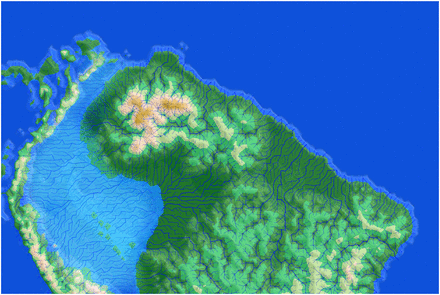
The Western Amazon Was a Sea?


Image credit: Tacio Cordeiro Bicudo (University of São Paulo, São Paulo, Brazil)


At intervals during the Miocene (23.03 to 5.333 million years ago) the Caribbean ocean surged into the western Amazon, creating a continuous inland sea. Saltwater currents mixed with fresh water from torrential rains. 

Researchers believe that the periods of flooding were relatively brief. For the majority of the epoch, the ocean receded, leaving a freshwater megawetland of interconnected lakes.

Scientists have found sediments as well as a fossilized shark tooth and a marine mantis shrimp, consistent with two separate Caribbean flooding periods in the last 20 million years. The geological and biological evidence suggests that during the Miocene the western Amazon region was a massive wetland, twice the size of Texas.

Read more here.


Saturday, June 3, 2017

The Topography of the Ocean Floor


Ever wonder what the bottom of the seas would look like without the water? Watch this video.

Iceland is separating at a rate of 1cm per year.


Related reading: Volcanic Eruptions and Climate