Followers

Showing posts with label technology. Show all posts

Friday, February 2, 2024

African American Contributions to Science and Technology


Madam C. J. Walker


This short video presents 10 exceptional individuals. They are:

Gerald "Jerry" A. Lawson (1940-2011) is known for his work in designing the Fairchild Channel F video game console as well as leading the team that pioneered the commercial video game cartridge.

Lewis Latimar (1848-1928) invented a method for producing a more durable carbon filament, making incandescent lighting practical and affordable for consumers.

Otis Boykin (1920-1982) invented electrical resistors used in computing, missile guidance, and artificial pacemakers.

Marc Hannah (1956-) developed the 3-D special effects systems used widely in movies.

Patricia Bath (1942-2019) invented laserphaco, a new device and technique to remove cataracts.

Alexander Miles (1838-1918) was awarded a patent for automatically opening and closing elevator doors.

Madam C. J. Walker (1867-1919) invented the world's first hair-straightening formula.

Garret Morgan (1877-1963) invented a three-way traffic light, and a protective 'smoke hood' notably used in a 1916 tunnel construction disaster rescue.

G. R. Carruthers (1939-2020) invented the first Moon-based astronomy observatory, which was placed by Apollo 16 astronauts on the lunar surface during his career at the U.S. Naval Research Laboratory.

Charles Richard Drew (1904-1950) developed improved techniques for blood storage and applied his knowledge to developing large-scale blood banks early in World War II.

Related reading: The Life and Faith of George Washington CarverHenrietta Lacks' Cells Advance Medicine


Wednesday, February 9, 2022

University of Delaware Engineers Attack CO2 Pollution


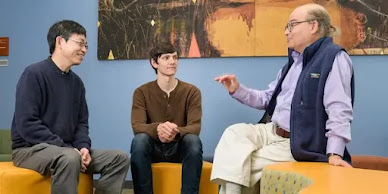
Three fuel cell experts discuss their project. From left to right, Yushan Yan, Brian P. Setzler, and Shimshon Gottesfeld. (Photo: Evan Krape)


The University of Delaware engineers captured 99% of carbon dioxide in the air when using their novel hydrogen-powered electrochemical system. The UD engineers have developed a fuel cell technology that uses cheaper catalysts and structural components, but these hydroxide exchange membrane fuel cells (HEMFCs) have a limitation. They cannot use direct supply of ambient air, because the carbon dioxide in the air reduces their performance.

The alkaline environment of hydroxide exchange membrane fuel cells potentially allows use of cost-effective catalysts and bipolar plates in devices. However, HEMFC performance is adversely affected by CO2 present in the ambient air feed. Here, we demonstrate an electrochemically driven CO2 separator (EDCS) to remove CO2 from the air feed using a shorted membrane that conducts both anions and electrons. This EDCS is powered by hydrogen like a fuel cell but needs no electrical wires, bipolar plates or current collectors, and thus can be modularized like a typical separation membrane.

The University of Delaware team has been attempting to improve fuel cell technology for over fifteen years. They realized that the sensitivity of the fuel cell to carbon dioxide, while detrimental to its efficiency in converting the chemical energy in fuel to electricity, meant it could be used as an effective tool for capturing carbon dioxide from the atmosphere.

An early prototype they developed using this approach, about the size of a 12-ounce (355 mL) soda can, could filter 10 liters of air per minute while scrubbing out >98% of the carbon dioxide present.

Brian Setzler, assistant research professor in chemical and biomolecular engineering and paper co-author explains, "Once we dug into the mechanism, we realized the fuel cells were capturing just about every bit of carbon dioxide that came into them, and they were really good at separating it to the other side," said

"It turns out our approach is very effective. We can capture 99% of the carbon dioxide out of the air in one pass if we have the right design and right configuration," said Professor Yushan Yan, Henry Belin du Pont Chair of Chemical and Biomolecular Engineering at the University of Delaware.

“This carbon dioxide problem has been with us for long enough, and we decided to turn the problem on its head and make it into a solution,” said Yan.

Read more here and here.  


Wednesday, December 4, 2019

Danger of Weaponized Robots


Robotics is a quickly expanding field. Robots are being built and used in the classroom, in medical labs, in security innovations, and in manufacturing plants. Unfortunately, they are also used to commit crimes, launch lethal attacks, and to impede airport operations.

Rapid advances have posed ethical dilemmas. Robots that can act autonomously could potentially inflict damage never intended by their designers. They can be weaponized by terrorists and political extremists.

In January 2017, the U.S. Department of Defense released a video showing an autonomous drone swarm of 103 individual robots successfully flying over California. Nobody was in control of the drones; their flight paths were choreographed in real-time by an advanced algorithm. The drones “are a collective organism, sharing one distributed brain for decision-making and adapting to each other like swarms in nature,” a spokesman said. The drones in the video were not weaponized — but the technology to do so is rapidly evolving.

Tuesday, August 27, 2019

Coming Soon: Smart Textiles


Laser printed wearable smart fabrics have a range of potential applications from monitoring vital signs of patients, to tracking the location and health status of soldiers, and monitoring pilots or drivers for fatigue.

Dr. Litty Thekkakara, a researcher in RMIT's School of Science in Melbourne, Australia, said smart textiles with built-in sensing, wireless communication or health monitoring technology called for robust and reliable energy solutions.

"Current approaches to smart textile energy storage, like stitching batteries into garments or using e-fibres, can be cumbersome and heavy, and can also have capacity issues," Thekkakara said.

Thekkakara and a team from RMIT University have developed a cost-efficient and scaleable method for rapidly fabricating textiles that are embedded with energy storage devices.

In just three minutes, the method can produce a 10x10cm smart textile patch that's waterproof, stretchable and readily integrated with energy harvesting technologies.

The technology enables graphene supercapacitors -- powerful and long-lasting energy storage devices that are easily combined with solar or other sources of power -- to be laser printed directly onto textiles.

Read more here.


Wednesday, November 22, 2017

Emerging Phone Service May Cost You


Phone companies will be more aggressive in blocking robocalls to customers' phones, but it may come with a cost.

The Federal Communications Commission yesterday issued an order to "expressly authorize voice service providers to block robocalls that appear to be from telephone numbers that do not or cannot make outgoing calls, without running afoul of the FCC's call completion rules."

The new authorization from the FCC applies to voice service providers including mobile phone carriers, traditional landline phone companies like AT&T and Verizon, and VoIP carriers such as cable companies.

Carriers will be "allowed to block calls purporting to be from invalid numbers, like those with area codes that don't exist, from numbers that have not been assigned to a provider, and from numbers allocated to a provider but not currently in use," the FCC said.

Read more here.


Wednesday, September 13, 2017

Robots that Hand Off Leadership


Retired mechanical engineer Paul Hanner helps students build a robot
 for the Meltdown Robo-Challenge at Newton’s Attic


A team of scientists led by Marco Dorigo (Free University of Brussels) has created robots that work together and decide which one will lead them. These autonomous robots know how to work as a team and even how to choose the best leader. By linking up, these Voltron-like robots can create a kind of central nervous system.

If the head robot breaks, another will take the lead. The team built a robot that can link up to another robot, react to its environment, and delegate authority to a single member of a group. The robots have an internal map of the robots that are connected to them, and that map looks like a hierarchical tree.

When two groups of robots join together, the leader of the first group can transfer its internal map of the other robots to the leader of the second group, giving up the leadership position.

Read more here.


Thursday, May 18, 2017

Chris Templar: Educational Technology's Bright Light


Alice C. Linsley

Chris TemplarI became acquainted with Chris Templar in October 2016 when I attended her fun and informative workshop on robotics in Winston-Salem, North Carolina. Chris Templar Ph.D., is one of the leading technology and robotics professors in the United States. She has been teaching for more than 35 years at Johnson University in Knoxville, Tennessee. The School of Education was named the Templar School of Education in honor of Dr. Templar. She was instrumental in the design and delivery of Johnson’s undergraduate and graduate teacher education programs; preparing the University for four state visits for Tennessee State approval of the teacher education programs; the design of the Chinese studies program, and taking the Master of Arts in Educational Technology project to Zhengzhou, China.

Dr. Templar's distinguished career continues through her recent appointment as director of international teacher education and director of educational technology, focusing her efforts on Johnson graduate students from The People’s Republic of China.

Alice Linsley: When did you realize that you wanted to serve Jesus Christ?

Dr. Templar: I became a Christian when I was 7 years old and was baptized at 13. I knew for as long as I can remember that I wanted to be a missionary to the Chinese.

Tell me about your childhood in England. What experiences shaped you and your later interests?

I grew up in a Christian home in England with very supportive parents. My parents were very committed to missions and brought me up to look up to missionaries as the Lord’s servants who were special people. When I was four to six years old the communists took over China and all the missionaries had to leave. I grew up in England and various China missionaries mainly from OMF and the BMS came to stay in my home. They were very shell shocked and weary. I did not understand this as a small child but I did understand that they loved China. One of them showed me a tiny shoe which she said a grown up lady wore.

At this very young age I learned to love China. I collected autographs of these people and most of them wrote a Bible verse in Chinese in my album. It was a very impressionable mark in my life. As I grew older I loved science and engineering, played with building kits and remember how much I wanted a chemistry set but that was a “boy’s” toy as was an erector set - called Meccano in England. I remember drilling holes in my dollhouse to wire it with electric lights. I was soundly punished this was just after the world war and toys were passed down from relatives as they were hard to find. I thought dolls were silly much to my mother’s dismay who felt she needed to develop the nurturing side in me. But I took the dolls I received to pieces to see how they worked! I remember receiving a new doll and taking it to pieces after I had been warned that I must not break it. So from an early stage I was certainly drawn to science and math. Today I would be a STEM child. I went to a British state school until 11 when I won a scholarship to a British public school. ( A high quality private school) This was a girls school and the headmistress wanted to help us see that girls could do things just as much as boys. She was years ahead of her time. I was placed in the math and physics stream and took O and A levels in these areas. But I decided I wanted to be a missionary and wanted to study Theology. This was very much opposed by my headmistress. But I landed up going to Leeds University to study Theology.

Who else influenced your life and future direction?

When I was in Leeds I met the person who was most influential in my life apart from my parents. Dr Verna Wright was a professor and head of the medical school at Leeds University. Verna was a dynamic Christian who believed in evangelism and also believed in mentoring students to see how to become dedicated to the Lord. Until he died he wrote me at least two or three letters a year prayed for me and helped me not only in Leeds but in so many different ways. From Leeds I moved to London University and completed my BA and M.Div and my Graduate Teaching certificate (the equivalent of teacher licensure). By then I had applied to OMF to become a missionary. The mission board insisted that I work at teaching for a year so that I had experience before going overseas. During the OMF training I met many China veterans and my love for the Chinese only developed. I did the Wycliffe Bible Translators summer linguistics program and learned Thai for a week but during that time I heard not one tone. So my results came with a recommendation that I not be sent to a tonal area and definitely not learn Chinese. OMF did some other testing at the University of London and each time the response came back that I could hear no tones and should not learn a tonal language. This appeared to close the door to that world. OMF and I decided that I would go to Indonesia. But wonder of wonders I was sponsored by a Chinese church who spoke Indonesian. They wanted me to teach in their seminary. I learned the language and spent four years there. I came to America for my furlough and worked on a M.A. and a Ph.D.

When the time came back I was unable to return to Indonesia and landed up with an invitation to Johnson University –then Johnson Bible College where they asked me to develop a teacher education program. On my second visit to JBC the Dean of Students said he had something special at his house and maybe I would like to see it. This was 1978 and he had the first model I TRS-870 that came to Knoxville. Five minutes playing with that computer and I was hook. I saw so much potential for computers with children and have played with computer and robots and other things ever since. As a result of this we taught the first required course for computers for teachers in Tennessee, and finally developed an accredited program at the masters and ed specialist level in educational technology. Gradually I have worked more on more on ed tech until now I do that all the time.

What do you love about your present work? What project has you excited?

I love working with graduate students, particularly the Chinese graduate students. I am really interested in the use of Robots and coding in the elementary and middle school and in the potential of the makerspace concept in the development of creativity with elementary and middle school children.

I am also very interested in the integration of Bible in the STEM environment.

What inspires you to try new things?

I just love trying everything new that comes along. Having two advanced degrees in ed tech I have to make sure that my department keeps up with the developments in the field. This means that I will always be trying new things.

Tell me about the naming of the Templar School of Education in your honor.

Johnson University honored me by naming the school of education the Templar School of Education after the work the Lord had enabled me to do in the founding and developing of the educational program.

Perhaps another great reward comes from the success of your students?

I have no children of my own, but I have many graduates’ children around the world who call me granny. All I do is done for the Lord and to glorify Him. I try to mentor my students just as Verna Wright mentored me.


Dr. Templar working with Chinese graduate students
Credit: Wade Payne, Special to the News Sentinel


How did you become involved with robots?

In 1981 I first went to MIT for the LOGO conference sponsored by Papert. In the discussion at the end of the conference they were identifying groups that were not represented at the conference. A Jewish gentleman stood up and said one other group not represented was the religious minority. Papert said that if ever they presented a proposal it would be considered. On the plane on the way home I drafted a proposal for a study of the book of Philippians and the visits Paul made to Philippi in Acts to be worked by 4-6th grade students in LOGO and drama.

The proposal I submitted was accepted and the following year I showed a video in which the faculty and staff children on our campus presented the results of their study and work. It was watched by a professor from Toyama University in Japan who stopped me on the sidewalk after the session and invited me to come to his university and present the material, which I subsequently did. This work with LOGO was my early experience of coding and fine arts combined with young children.

Computer education moved away from the creative discovery approach to the use of computers with children favored by Seymour Papert and others, becoming much more structured. But the pendulum has swung back to the more creative discovery approach. I have run pilot programs and graduate classes with various robots for children, taught cad software (Tinkercad) to children as young as 3rd grade, and worked with them as they have seen the success of their 3D printed objects. 

I also have worked with professors from Anhui Normal University in China to help them develop makerspace and robotic courses for their masters programs in educational technology.  I have found that the opportunities to share with teachers both in America and China have expanded exponentially. After fifteen trips to China to teach in the area of educational technology and robotics I am settling down to teach the Chinese who come to me. One of my graduates is following in my footsteps and going to China to teach this summer.

While I have worked for the majority of my professional life in some aspect of technology it has always been my desire to integrate the Lord, His Word, and His ways into the work I am doing.  I have never found this hard to do. The things we use in educational technology were created by the Lord, and in all things I seek to give glory to Him. 

Wednesday, March 8, 2017

Want to Be a Computer Programmer?


These programmers pioneered the IMB computers shown here. The computers were so large they filled an entire room. Not very practical for today's needs.

Today computers are everywhere. Computer people are dreamers and inventors. They think of something cool and then they write the program to make it happen.

There are an estimated 500,000 positions open for computer programmers. Consider a career that most certainly has a place for you.

Check it out here.


Friday, March 3, 2017

The World Map Without Distortions


The maps we have become accustomed to are based on a map first produced in the 1600s. These maps are not accurate in their representations of the comparative square miles of the different regions. For example, Europe is shown as being larger in size than South America. Yet Europe is 3.8 million square miles whereas South America is 6.9 Square miles.

Another example is a comparison of the land masses above and below the equator. The regions above the equator are shown as larger, yet the regions below the equator cover 38.6 square miles, whereas the regions above the equator cover only 18.9 square miles.

Watch this video to see what the map of the world should look like.

Related:  Why the Maps You See Are Wrong; Renaissance Mapmaker Was a Mastermind and a Copycat; How Globes Were Made in the 1950s; A Brief History of Globe Making


Thursday, March 2, 2017

Old Maps and Globes


Map making is called cartography.


Many peoples have shown interest in the earth and the relationship of continents and territories, including the Egyptians, Babylonians, Greeks and Romans. The Stoic philosopher, Crates of Mallus, fabricated a globe around the year 150 BC. Crates' globe is very interesting because he speculated that there must be a land mass where North America is located. He thought this must be so because he believed that the earth's balance required symmetry. In other words, the part of the world that he knew about required the existence of a counterpart on the other side of the globe.

The oldest surviving terrestrial globe was made in 1492 by the German mapmaker Martin Behaim (1459–1537). He had the globe painted by Georg Glockendon. Behaim's globe is known as the Nürnberg Terrestrial Globe or the Erdapfel (German - "earth apple").

The year 1492 was an important year in Western history. Columbus discovered the West Indies, and King Fernando and Queen Isabela united Spain for the first time. Soon after, Spain began to explore the Americas and founded colonial cities in Mexico, Cuba, Puerto Rico, Florida, and South America. 

Behaim's depiction of the world was not inaccurate, especially in relation to the west coast of Africa and North America, about which he knew nothing. His globe is in the collection of the German National Museum in Nürnberg.

Wednesday, March 1, 2017

How Parchment is Made


From the earliest times, humans have written on many surfaces: ostrich egg shells, stone, wood, the walls of caves, papyrus, and the skins of animals, called parchment. This video explains how parchment is made.


Many important documents were produced on vellum (parchment). One example is the Magna Carta Libertatum (The Great Charter of Liberties) which is kept at the British Library. This historic document (shown below) is written in Latin on vellum.


Magna Carta of 1215


Watch this video to see how illuminated manuscripts were produced in the Middle Ages.


Related reading: Early Written Signs; Ancient Canaanite Inscriptions


Wednesday, September 21, 2016

Technology to Preserve Languages on the Verge of Extinction


Credit: Ryan Red Corn (Osage)

There are many endangered languages in our collective linguistic radar. Some of them have been covered here before and some haven’t. In 2007, Joshua Hinson of Chickasaw heritage, identified that his language was one the brink of extinction. Rather than blaming technology as contributing source to language loss, Hinson embraced the opportunity to use technology to help save his language.

When Hinson saw that his ancestral Chickasaw language was disappearing, he decided to help build an online presence and create a smartphone app to make the language accessible.

Hinson used the internet to build an online presence for his tribe. This has been done before, as recently as in 2012 when Google embraced theEndangered Languages Project. Hinson almost a poured a decade into theChickasaw Language Revitalization Program, and by now knows enough Chickasaw to hold conversations as well as to read and write. As I understand it, at 32 years old, he is youngest member of the language to speak fluently, the next youngest member is 62.

Read the full article here.

Related reading: Dr. Nola Stephens on Linguistics and Faith

Friday, July 29, 2016

Science and Technology in the Ancient World


Alice C. Linsley

In a conversation with self-proclaimed atheists, I was told that theology and religion emerged because people who lived before the time of science needed to explain natural phenomena. The implication is that we no longer need religion now that we have science. I attempted to explain that the earliest developments in science were motivated by religious concerns, but they were not interested. Their minds were closed and reasoning with them proved a waste of time.

As the Romanian sociologist Mircea Eliade has shown, people of antiquity believed that things on earth are patterned after things in the heavens. Eliade called these “celestial archetypes.” The notion “as in the heavens, so on earth” is common among tribal peoples. Their rituals and ceremonies mirror the celestial patterns which they observe in the clock-like motion of the fixed stars and constellations. Among archaic peoples, these observations were done by a caste of ruler-priests who served at advisers to the high king.

It was a risky business because there were serious consequences if their calculations were wrong. If the ceremony was not performed on exactly the right day, the advisers could be blamed for violating a celestial pattern. If war broke out, or the crops failed, or there was a flood, the ruler’s advisers were blamed. This happened to Chinese astronomers who failed to predict the solar eclipse of 2134 BC. The emperor ordered that they all be executed.

The threat of punishment, even death, motivated the king’s advisers to be as accurate as possible in their calculations. This led to the development of sidereal astronomy. The sidereal day (four minutes longer than the solar day) is the time required for the earth’s rotation to be synchronized with fixed stars. Solar time is the measurement of time according to the earth’s rotation around the sun, but sidereal time is the measurement relative to a distant star. It is used in astronomy to predict when a star will be overhead.

When making ethical decisions, especially decisions that pertained to the timing of important events such as royal weddings and the signing of treaties, ancient peoples relied on observations of the stars and constellations which move in a fixed pattern. Sidereal astronomy is based on the actual location of stars and constellations, unlike popular astrology which is based on culturally-relative symbolism associated with stars and constellations. Sidereal astronomy developed out of an ethical concern to uphold the celestial pattern believed to have been established by the Creator in the beginning.

This worldview is alien to modern Americans and regarded as superstition by atheists. Yet the acute observation of ancient peoples gave birth to technologies such as metal and stone work and to the development of sciences such as horticulture, animal husbandry, sidereal astronomy, and medicine.

Let us consider a few examples.


Metal Work

Timna in the Arabah Valley is the site of 6,000 years old mines and a temple. The oldest mines were worked almost continuously until the Roman Period. There are ancient rock carvings showing warriors in chariots, holding axes and shields. A temple dedicated to Hathor was discovered at the southwestern edge of Mt. Timna by Professor Beno Rothenberg of Hebrew University.

The Chalcolithic metal works at Timna were found at the Wadi Nehushtan in the foothills along the western fringe of the southern Arabah Valley. The smelting works, slag and flints at this site were found to be identical to those discovered near Beersheba where Abraham spent much of his time. The metal workers of Timna and the metal workers of Beersheba were kin and the patroness of their mining operations was Hathor, the mother of Horus, who the Horite venerated. Hathor's temple there dates to 1318-1304 BC. In the temple courtyard there was a workshop for casting copper figurines as votive offerings.

In his book Timna, Rothenberg concluded that the peoples living in the area were "partners not only in the work but in the worship of Hathor." (Timna, p. 183)

Stone Work

One of the earliest occupations of Man was stone work. Sharp-edged flakes, flake fragments, and cobbles have been dated to between 2.5 and 2.6 million years. These were discovered at three sites along the Gona River in the Afar region of Ethiopia. Similar stone tools, known as Oldowan, have been found at Omo in southern Ethiopia, Lokalalei in northern Kenya, and Hadar, five miles east of the Gona River study area.

At Kathu in South Africa, archaeologists collected many thousands of stone tools and products of tool making in a few sample pits over a several acres.

On the Arabian Peninsula, the Qafzeh population created stone tools 125,000 years ago at Jebel Faya. These suggest that humans reached the Arabian Peninsula not from the Lower Nile Valley 119,000 to 81,000 years ago or from the Mediterranean shores 65,000 to 40,000 years ago, but much earlier from the Horn of Africa. The oldest tools were dated to approximately 120,000 years ago, and included denticulates, end-scrapers, foliates, hand axes, and side-scrapers.

Some prehistoric stone artifacts were not used as tools. The Blombos Cave Plaque, dating to 80,000 years PB, may have served as a calendar or a counting device. Stone was ground to make dyes. Red ochre was extracted from mining operations in the Lebombo Mountains. This red powder was used almost universally in the burial of nobles between 45,000 and 2000 BC.

The oldest known stone temple is at Göbekli Tepe in Turkey. Göbekli Tepe is classified as a Pre-Pottery Neolithic site (PPN). It is designated PPNA (ca 10,500 to 9,500 BC) which puts it in the same class as Jericho, Netiv Hagdud, Nahul Oren, Gesher, Dhar', Jerf al Ahmar, Chogha Golan and Abu Hureyra. Göbekli Tepe is one of the sacred "high places" of the ancient world.

Stone workers of the ancient world build stone tombs for their chief priests and kings. Egyptian archaeologists discovered a 4400-year-old tomb, south of the cemetery of the pyramid builders at Giza, Egypt. The ancient tomb was unearthed near the pyramid builder's necropolis. The tomb belongs to a priest named Rudj-Ka (or Rwd-Ka), and is dated to between 2465 and 2323 BC. Rudj-Ka was a priest who performed purification rituals for those who bore blood guilt and who had become contaminated through contact with blood or a corpse.

Horticulture

The ancestors of the Nes craftsmen of Anatolian sites like Gobleki Tepe cultivated both einkorn and emmer wheats about 12,000 years ago, according to genetics and archaeological studies. African rice was domesticated from the wild ancestor Oryza barthii (Oryza brevilugata) by peoples living in the Benue-Niger floodplain about 3,000 years ago. Rice grain formed the basis of weight measurement from East Africa to Sulawesi. On Madagascar, the the weight of one grain of rice is called vary, and corresponds to the Swahili wari and to the Dravidian verasu. The common stem of these words indicates that these people kept written records of commercial weights.

The ancients observed that the seeds of plants that fall the to ground produce other plants. It was therefore logical and accurate to assume that the seed that should fall to the earth is the seed of plants, which spring forth from the earth. Likewise, the seed of man should fall on his own type (the womb), from which man comes forth. This was regarded as the divine-established pattern. Therefore, the ancients regarded both onanism (spilling of human semen) and homosex to be acts in violation of the order of creation. This is the ancient wisdom that based moral law on observed patterns in nature.

Animal Husbandry
Red and black Nubian cattle herders

Cattle were domesticated in what is today Kenya 15,000 years ago. The common term for cattle or cow in the many African languages is nag (Wolog, Fulani), nagge (Hausa), ning (Angas, Ankwe) and ninge (Susu). This corresponds to the Egyptian word ng or nag.

Cattle bones were found in graves of the elite classes at Hierakonpolis (Nekhen in Sudan) and cow skulls were used to mark the pan graves of the ancient Saharans. The oldest evidence of domestication of wild pigs is found at Nekhen, Maadi, Abydos, and Armant. Here graves belonging to the commoners, indicate that the diet of the lower classes included pork. Cows were also domesticated by the Nilo-Saharans, who even took them on their boats (see second image below).


Boats and cows of the ancient Nilo-Saharans

Sidereal Astronomy

Sidereal astronomy is real science based on observation of the arrangement and movement of the fixed stars and planets. This science originated among Abraham's Nilo-Saharan ancestors who had recorded information about the fixed stars and clock-like motion of the planets and constellations for thousands of years. By 4245 BC, the priests of the Upper Nile had established a calendar based on the appearance of the star Sirius that becomes visible to the naked eye once every 1,461 years. Apparently, they had been tracking this star and connecting it to seasonal changes and agriculture for thousands of years. The priest Manetho reported in his history (241 BC) that Nilotic Africans had been “star-gazing” as early as 40,000 years ago. They shared this knowledge with the kings of Egypt.

The ancient Egyptians shared the knowledge with the ancient Greeks. Plato claimed that the Africans had been tracking the heavens for 10,000 years. Plato studied with an Egyptian priest for 13 years and knew about Earth's Great Year, also called the "Platonic Year." This is the time of between 25,000 and 28,000 years that it takes for Earth to complete the cycle of axial precession. This precession was known to Plato who defined the "perfect year" as the return of the celestial bodies (planets) and the diurnal rotation of the fixed stars to their original positions.

The ancients were motivated to understand the celestial pattern because they believed that the order in creation was fixed by the Creator and they were concerned about trespassing boundaries or violating the order in creation. They believed "As in the heavens, so on earth."

Medicine

The Edwin Smith papyrus is the world's oldest known surgical document (c. 1600 BC). It is written in the hieratic script of ancient Egypt and Kush and reveals a high level of sophistication in medical care. It gives detailed descriptions of anatomy, diagnosis, treatment, and prognosis of forty-eight types of medical problems. It describes closing wounds with sutures, preventing and curing infection with honey and moldy bread (both known to contain antibiotics), application of raw meat to stop bleeding, and treatment of head and spinal cord injuries. The Nubians also used antibiotics. Between 350 and 550 AD Nubians laced their beer with tetracycline.


Related reading: Ethics and Archaic Communities; Ancient Seats of Wisdom; Who Were the Wise Men?; The Wisdom of Yeshua Ben Sira; Plato's Debt to Ancient Egypt; Early Metaphysics: Primal substance and cause; The Urheimat of the Canaanite Y; Medical Care in Ancient Egypt; The Antiquity of the Edomite Rulers